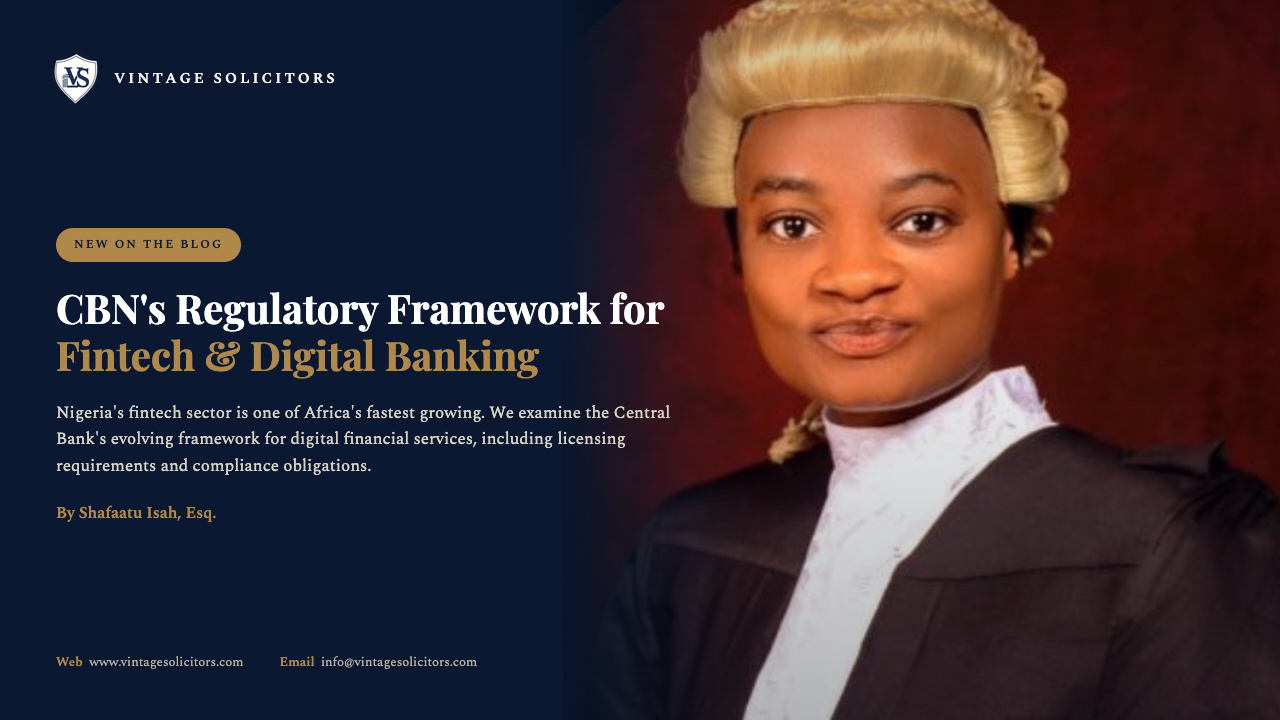
The CBN's Fintech Rulebook: Why "Move Fast and Figure Out Compliance Later" No Longer Works
Nigeria's fintech sector built its early reputation on speed. Products launched fast, user bases scaled faster, and for a long stretch, compliance was something founders promised investors they would "sort out" once the company had enough traction to justify hiring a legal team. That era is over. The Central Bank of Nigeria has spent the past few years closing the gap between how quickly fintechs move and how tightly they are regulated, and as of 2026, that gap has effectively closed. What used to be a patchwork of guidelines is now an active, enforced regulatory stack with real deadlines and real consequences for getting it wrong.
The licence you actually need, not the one you think you need
Nigeria's fintech licensing regime is built around function, not branding. It does not matter what a company calls itself; what matters is what it actually does with money and data, and the CBN has drawn fairly sharp lines around each category.
If your business routes, clears, or settles transactions between other players, sitting in the infrastructure layer rather than facing customers directly, you likely need a Switching and Processing licence, which carries a substantial capital requirement in the billions of naira. This is the tier that companies handling core payment infrastructure operate under.
If you are building a wallet-based product competing directly with the major telecom-backed money services, the Mobile Money Operator licence applies, and it comes with its own significant capital and escrow obligations. Somewhat lighter tiers exist for Payment Solution Service Providers and Payment Terminal Service Providers, each with capital thresholds scaled to the risk profile of what they do. A company aggregating merchant payments or processing card transactions on terminals does not carry the same systemic risk as one operating a nationwide switch, and the licensing tiers reflect that.
The practical trap here is founders assuming their product is "just an app" and therefore exempt from all this. If money moves through it, in almost every case, some CBN authorization applies, and operating without the correct one is not a paperwork oversight the regulator treats lightly.
Open banking is no longer a concept, it is a compliance deadline
For years, open banking in Nigeria existed mostly as an aspiration, something regulators talked about at conferences while banks quietly resisted sharing customer data with third-party fintechs. That changed with the CBN's Open Banking Framework, which set out actual API standardisation requirements for payment service providers and lenders. What started as a framework is now moving into active enforcement, with banks and fintechs expected to build the technical infrastructure to support standardised, secure data sharing rather than the ad hoc screen-scraping arrangements that used to pass for "integration."
For fintechs whose entire value proposition depends on accessing customer financial data from banks, this is not a peripheral regulatory update. It is the plumbing their business model runs on, and getting on the wrong side of the compliance timeline here can mean losing access to the very data pipes that make the product work.
Anti-money laundering just went from "policy" to "real-time"
One of the more consequential shifts recently has been the CBN's move toward mandating real-time AML monitoring rather than the periodic, after-the-fact reporting that institutions previously relied on. The direction is clear: transaction monitoring systems need to flag suspicious activity as it happens, not in a compliance report filed weeks later. For fintechs operating at consumer scale, this typically means investing in monitoring infrastructure that many smaller players had previously treated as a "someday" expense.
Data protection has teeth now
The Nigeria Data Protection Act and its accompanying General Application and Implementation Directive brought data protection obligations that fintechs cannot treat as a formality anymore. Given how much personal and financial data flows through a typical fintech product, from BVNs to transaction histories to device data used for credit scoring, this framework now sits directly alongside CBN licensing as something enforcement actions can and do target.
The crypto question finally got an answer, sort of
For years, Nigeria's regulatory posture on cryptocurrency swung between restriction and ambiguity, culminating in the CBN's 2021 directive effectively cutting banks off from crypto exchanges. That position shifted in December 2023, when the CBN introduced a structured licensing framework allowing banks to work with licensed virtual asset service providers under defined conditions. It is not a wholesale embrace of crypto, but it is a meaningful departure from outright restriction, and it signals that the CBN would rather regulate this space than continue pretending it does not exist. Fintechs building anything crypto-adjacent should treat this framework, not the old 2021 directive, as the current baseline.
Where this is heading
What is notable about the CBN's recent posture is that it is not just issuing rules and walking away. There is a broader reform effort underway, including proposals for a formalised Fintech Advisory Council and a dedicated internal secretariat to make sure implementation does not stall the way past initiatives sometimes have. Whether that materialises as promised remains to be seen, Nigerian regulatory reform has a track record of bold announcements followed by uneven follow-through, but the direction of travel is unmistakable: more structure, more enforcement, and less tolerance for fintechs treating regulation as optional.
What this means if you are building or investing in fintech right now
The single most useful thing a founder or investor can do in this environment is stop treating licensing as a box to tick after the product works and start treating it as part of the product architecture itself. Which licence category applies, what capital and escrow obligations come with it, how the open banking and AML requirements affect your technical roadmap, these are not legal afterthoughts anymore. They shape what you can build, how fast you can scale, and whether the business survives its first serious regulatory audit.
If you are navigating any part of this, correctly classifying your product against the CBN's licensing categories, structuring around the open banking requirements, or figuring out where crypto-adjacent activity now sits, that is exactly the kind of question worth getting a clear answer to before you build around the wrong assumption.
Vintage Solicitors (Adeolu Salako SAN & Co.) | 9 Rumbek Close, Wuse Zone 6, Abuja, FCT. This article is for general information only and does not constitute legal advice.
Back to Legal Insights